Wrist-Deep in Data: The Honest Guide to Swim Trackers Worth Buying in 2025
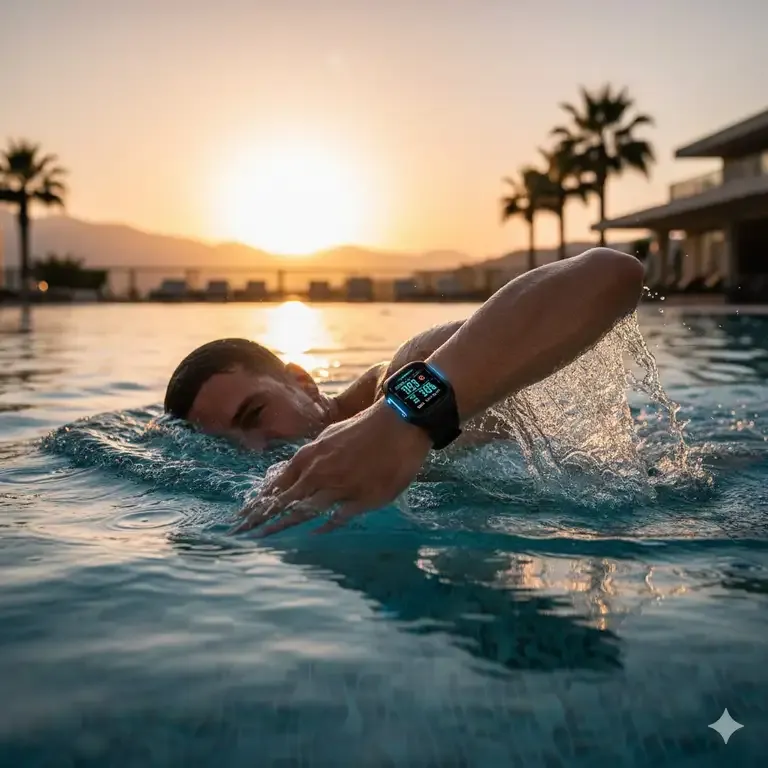
Photo: smartwatch swimmer wrist pool training gear technology, via watchwisehub.com
There's a version of this article that just lists specs and star ratings. This isn't that version. If you're a competitive swimmer trying to train smarter — not just train more — you need to know which devices are actually going to change how you prepare, and which ones are going to give you a pile of numbers that don't tell you anything useful.
The swim tracker market has grown fast. There are now options at nearly every price point, from sub-$150 fitness watches to purpose-built training tools pushing $500. The specs sheets all sound impressive. But specs don't swim. Let's talk about what actually matters.
What Useful Swim Data Actually Looks Like
Before you spend a dollar, it's worth getting clear on what metrics genuinely move the needle for competitive swimmers. There's a lot of data these devices can collect, and a much shorter list of data that should influence your training decisions.
Stroke count and SWOLF — SWOLF (strokes per length plus seconds per length) is a composite efficiency metric. It's not perfect, but it gives you a real-time read on whether you're getting more out of each stroke or just spinning your wheels harder. Consistent SWOLF tracking over weeks tells you if your technique is actually improving.
Interval pacing and split accuracy — This is where a lot of devices fall apart. Automatic lap detection is notoriously unreliable in shorter pools (25 yards versus 25 meters) and can miss or double-count laps during open turns or slower swimmers. A device that miscounts laps is actively harmful to your training data.
Heart rate accuracy in water — Optical wrist-based heart rate in the pool is still imperfect across the board. Water movement creates noise. The better devices compensate reasonably well during steady-state swimming; the cheaper ones give you numbers that are basically fiction during sprint sets.
Recovery metrics — HRV (heart rate variability), resting heart rate trends, and sleep tracking don't tell you how fast you swam. They tell you how ready you are to swim fast. For athletes in heavy training blocks, this context is genuinely valuable.
The Garmin Swim 2: Still the Standard for Dedicated Swim Tracking
If you want a device built specifically for pool swimming and nothing else, the Garmin Swim 2 remains the most reliable option in its class. Lap detection is accurate, stroke detection handles all four competitive strokes without much fuss, and the SWOLF data is consistent enough to actually trend over time.
It's not trying to be a general fitness watch or a smartwatch. That focus shows. Battery life is excellent for pool use, the interface is straightforward, and the Connect app gives you enough post-session breakdown to identify patterns without drowning you in irrelevant data.
The downside: it's a single-purpose device. If you cross-train heavily, run, or want everyday wearable functionality, you're carrying two devices. For pure pool athletes, that's a reasonable trade. Street price hovers around $200, which is fair for what it delivers.
The Apple Watch Ultra 2: Capable, But Know What You're Buying
Apple's high-end watch has gotten legitimately good at swimming. The Ultra 2 handles pool detection, stroke recognition, and pace tracking with accuracy that's competitive with dedicated swim devices. The real appeal is the ecosystem — if you're already in Apple's world, the Health app integration is seamless, and third-party apps like MySwimPro layer on top effectively.
Heart rate in the water is better than most optical sensors at this price, though still not reliable enough to base sprint-set intensity off of without cross-referencing.
The honest caveat: you're paying for a lot of features that have nothing to do with swimming. If the smartwatch functionality matters to you, the Ultra 2 is genuinely excellent. If you just want the best swim data per dollar, there are better options at half the price.
Garmin Forerunner 965 and Fenix 7: The Multi-Sport Athlete's Sweet Spot
For swimmers who also run, bike, or compete in open water, the Garmin Forerunner 965 and Fenix 7 series hit a strong balance. Both handle pool swimming metrics comparably to the Swim 2, while adding GPS for open water, robust running dynamics, and Garmin's Training Readiness score — which pulls together HRV, sleep, and training load into a daily readiness number that's actually useful.
The Fenix 7 is the more rugged option with a longer battery life. The Forerunner 965 is lighter and better suited for daily wear. Both run $500-$600, which is a real commitment, but for serious multi-sport competitors, the data consolidation justifies the price more often than not.
Whoop 4.0: Recovery Data Without the Swim Metrics
Whoop takes a different angle entirely. It doesn't track stroke count or split times — it's not trying to. What it does, better than almost anything else at its price point, is recovery monitoring. HRV trends, sleep staging, and strain tracking give you a daily picture of your physiological readiness that translates directly into smarter training decisions.
The catch is the subscription model ($239/year after the free band), and the fact that it won't replace your in-pool tracking device. Think of Whoop as a complement to your swim tracker, not a replacement. Athletes who pair it with a Garmin Swim 2 get the best of both worlds — detailed in-pool metrics plus recovery context that tells you what to do with those metrics.
Training Apps: Where the Real Value Often Lives
Hardware gets the attention, but the app layer is where a lot of competitive swimmers are finding the most actionable value. MySwimPro remains the most complete training app in the space, with structured workouts, video technique references, and solid device integration. The premium tier ($79.99/year) is worth it if you're using it consistently.
Swimtag and Swim.com offer community features and workout logging that work reasonably well, though neither matches MySwimPro's training structure depth.
If your pool uses Finis CX-1 or similar underwater audio systems, the integration with training apps adds a layer of real-time coaching feedback that wearables alone can't replicate.
What to Buy Based on Where You're At
Newer competitive swimmers (high school, first few years of club): Start with the Garmin Swim 2. Learn what SWOLF means for your specific strokes, build the habit of reviewing your data after sessions, and don't overcomplicate it. A $200 device you actually use beats a $500 device you ignore.
Serious club and collegiate swimmers: The Garmin Forerunner 965 or a Garmin Swim 2 paired with Whoop gives you a complete picture. Add MySwimPro for structured training if your coach's programming has gaps.
Multi-sport and open water athletes: The Fenix 7 or Apple Watch Ultra 2 makes sense if you need GPS and cross-sport tracking. Just don't expect open-water heart rate data to be competition-grade.
The Bottom Line
The best swim tracker is the one that gives you data you'll actually act on. More metrics isn't better if you don't know what to do with them. Start with the basics — splits, stroke efficiency, recovery trends — and build from there. Your times will tell you if it's working.