Your Turns Are Costing You Seconds: The Physics Behind a Race-Winning Flip
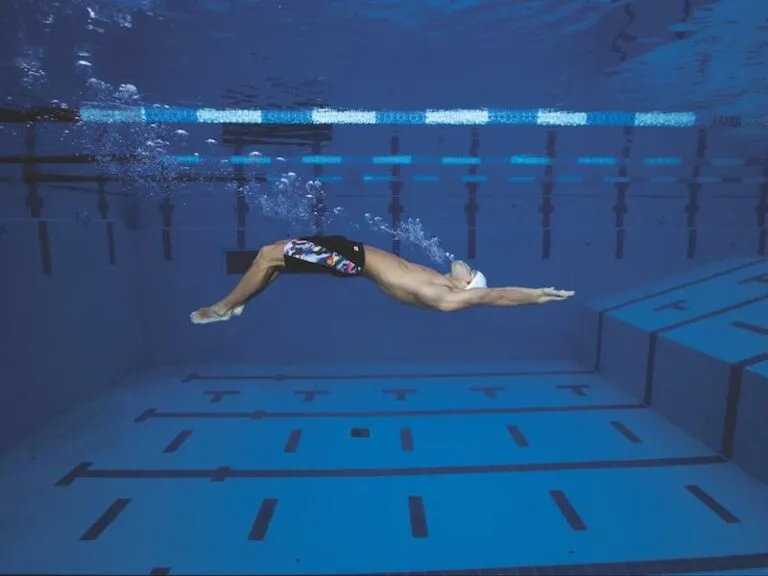
Photo: competitive swimmer flip turn underwater pool wall push-off, via blog.arenaswim.com
Here's a number that should get your attention: in a 100-yard freestyle race, you hit the wall four times. Four opportunities to either rocket off the touchpad like a compressed spring or bleed momentum like a leaky faucet. For most recreational and even club-level swimmers, those turns are the single biggest untapped source of free speed in the pool.
We're not talking about tenths of a second here. Fix a broken flip turn and you can realistically shave two to four seconds off a 100-yard time—without swimming a single extra yard in practice.
So what's actually happening at the wall, and why do so many swimmers get it wrong?
The Moment That Defines Your Race
When you break down the physics of a flip turn, it comes down to one core principle: momentum is your currency, and the wall is your bank. The speed you carry into the turn is energy you can either preserve and amplify or waste entirely.
The approach is everything. Most swimmers start decelerating too early—they see the T-line on the pool floor and unconsciously begin to slow down, as if braking before a stoplight. Elite swimmers do the opposite. They drive into the wall with controlled aggression, keeping their stroke rate up through the final stroke cycle.
At the elite level, swimmers like Ryan Murphy and Katie Ledecky maintain near-peak velocity until their feet make contact. That momentum doesn't disappear—it transfers directly into push-off power. When you slow down approaching the wall, you're essentially showing up to that transaction with an empty wallet.
The Three Mistakes Killing Your Turns
1. The Death Glide This is the most common sin. A swimmer takes their last stroke, then coasts for a stroke or two before initiating the somersault. That glide feels natural, even controlled, but it's a momentum killer. The fix? Count your stroke cycles from the flags. The backstroke flags are 15 feet from the wall—learn your personal stroke count from that point and commit to it every single time. No guessing, no gliding.
2. The Crooked Somersault A flip turn should be a tight, vertical rotation—think of rolling over a barrel placed directly in front of you. When swimmers initiate the turn with their head tilted to one side or their arms pulling unevenly, the rotation goes sideways. You end up on the wall at an angle, which means your push-off goes sideways too. Practice your somersault in the middle of the pool, away from the wall. Tuck your chin to your chest, pull both arms down symmetrically, and feel the rotation stay square.
3. The Flat Push-Off This one is subtle but devastating. When your feet hit the wall and you push off completely flat—parallel to the surface—you're fighting drag from the very first inch of your streamline. The optimal push-off angle is slightly downward, around 10 to 15 degrees below the surface. This keeps you in that sweet spot where you're deep enough to avoid surface turbulence but shallow enough to break out efficiently. Most swimmers push off too shallow, popping up to the surface before their momentum has a chance to carry them.
The Push-Off Window: Depth, Angle, and Timing
Your feet should land on the wall somewhere between 12 and 18 inches below the surface. Too deep and you're fighting your way back up; too shallow and you're catching wave drag from your own breakout. The ideal push-off has your body in a tight streamline—arms locked overhead, biceps squeezing your ears, ankles together—before you even begin to extend your legs.
The push-off itself should be explosive and complete. Think about driving through the wall, not just touching it. Hold that streamline until you feel your speed drop below your swimming pace, then initiate your breakout kick. Breaking out too early is one of the quieter time-wasters in competitive swimming. Let the wall work for you.
Dryland Drills That Actually Transfer
You don't need a pool to build better turn mechanics. Some of the most effective work happens on dry land.
Tuck-and-Roll on a Mat: Lie on your back and practice the tucking motion—pull your knees to your chest, roll your hips over, and plant your feet on the mat in a simulated push-off position. Focus on keeping the rotation straight and centered. This builds the muscle memory of a symmetrical somersault without the disorientation of doing it underwater.
Wall Push-Off with a Resistance Band: Stand with your back to a wall, loop a light resistance band around your waist, and practice the explosive leg drive of a push-off while holding a streamline position with your arms. It sounds simple, but it trains the connection between foot contact and full-body tension that a lot of swimmers never develop consciously.
Underwater Streamline Holds: In the pool, push off the wall from a standstill and count how far you travel before breaking the surface. Over time, work to extend that distance. This builds both the strength and the body awareness to hold a tight, efficient streamline under race conditions.
The Compound Effect Across a Race
Here's why this matters so much in a 100-yard race specifically. You have four turns. If each improved turn saves you half a second—which is genuinely conservative once you've fixed the major errors—that's two full seconds off your time without changing anything about your actual swimming. In a sport where hundredths of a second separate heats, two seconds is a lifetime.
At the 200-yard level, the math gets even more compelling. Eight turns, each one a chance to either build or bleed speed. Elite coaches often say that the 200 free is won and lost at the walls, not in the open water.
Start treating your flip turns the way you treat your stroke. Film them, analyze them, drill them obsessively. The wall isn't just the end of a lap—it's the fastest part of your race, and right now, you might not even be showing up for it.
Gear up, work the walls, and go find those seconds.