One Side Strong, One Side Slow: How Your Breathing Pattern Is Quietly Wrecking Your Freestyle
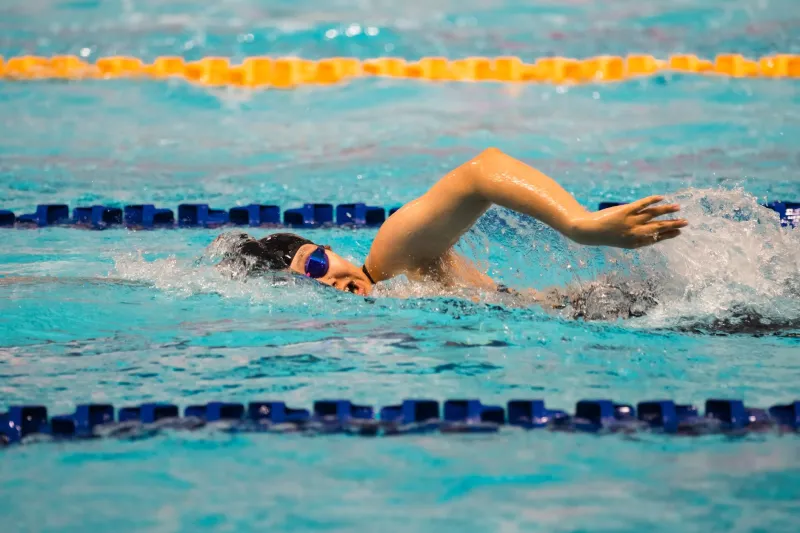
Ask a room full of competitive swimmers whether they breathe bilaterally and about half will say yes. Ask them whether they breathe symmetrically — meaning both sides with equal mechanics, equal rotation, and equal head position — and the honest answer from most of them would be a lot less confident.
There's a difference between breathing every three strokes and actually breathing with balance. And that difference, according to coaches who work with elite-level age groupers and masters swimmers alike, can represent two to three seconds per hundred meters in freestyle events. Not from fitness. Not from technique work. Just from fixing which way your head turns.
Why Asymmetry Develops in the First Place
Breathing preference is almost universal in swimmers. Just like handedness, most people develop a dominant breathing side early in their swimming career — often before they're even aware it's happening. For a lot of age group swimmers, coaches introduce bilateral breathing as a pattern (every three strokes) but never closely monitor whether the mechanics on both sides are actually equivalent.
The result is a swimmer who technically breathes bilaterally but does so with meaningfully different head rotation, different body roll, and different timing on each side. Over thousands of yards of practice, the dominant side gets reinforced. The weaker side gets sloppy. And the gap between them quietly widens.
Biomechanically, what's happening is this: when you breathe, you're interrupting your body's horizontal rotation cycle. If your left-side breath requires more head rotation to clear the water than your right-side breath, your body is making a compensatory adjustment on every left-side stroke. That compensation typically shows up as a dropped hip on the opposite side, a shortened pull, or a disrupted kick rhythm — all of which create drag.
What the Data Actually Shows
A small but growing body of research in applied swimming biomechanics has started to quantify what coaches have suspected for years. Asymmetrical breathing patterns correlate with measurable differences in body roll between stroke cycles, which directly affects drag coefficient.
One study tracking collegiate-level freestylers found that swimmers with more than 12 degrees of difference in body roll between breathing sides showed statistically worse times per 100 compared to their physically matched peers with more balanced rotation. The drag penalty from that asymmetry was roughly equivalent to wearing a less hydrodynamic suit.
More practically, coaches at several prominent US club programs have reported that systematic bilateral breathing correction — not just adding more bilateral breathing, but fixing it — produced time drops of 1.5 to 3 seconds per 100 freestyle in swimmers who had otherwise plateaued. No new fitness work. No stroke overhaul. Just symmetry.
Case Studies: What Fixing This Actually Looks Like
Swimmer A — a 17-year-old club swimmer competing at the senior level — had been stuck at 53-low in the 100 free for two seasons. Video analysis revealed that her left-side breath involved nearly 20 more degrees of head rotation than her right, causing a consistent hip drop and a shortened left-arm entry. Eight weeks of targeted bilateral correction drills brought her to 51.4.
Swimmer B — a masters swimmer returning to competition after a decade away — had never been coached on bilateral breathing at all. He breathed exclusively to his right. After six weeks of progressive bilateral integration, his 200 free dropped from 2:08 to 2:05, with the improvement attributable almost entirely to reduced drag from more consistent body position.
These aren't outliers. They're representative of what happens when a fundamental flaw gets addressed directly.
How to Diagnose Your Own Imbalance
You don't need a motion capture lab to identify bilateral asymmetry. Here are three practical diagnostics:
The video test. Have someone film you from directly behind as you swim a 50 at race pace. Watch for differences in how far your hips drop on each breathing side and whether your body roll is consistent across the stroke cycle. If you see a visible difference, you have an imbalance.
The effort perception test. Swim two 50s at the same pace — one breathing exclusively to your dominant side, one to your non-dominant side. If the non-dominant side feels significantly harder or if your stroke feels noticeably different, your mechanics aren't equivalent.
The split check. If your coach has access to split-stroke timing technology, compare your stroke rate and distance-per-stroke between breathing sides. Meaningful differences are a red flag.
The Corrective Training Plan
Fixing bilateral imbalance isn't about swimming more bilateral breathing sets. It's about isolating and correcting the mechanics on the weaker side before reintegrating it into your full stroke.
Phase 1 — Isolation (Weeks 1-2): Spend 15-20% of your daily yardage swimming exclusively on your non-dominant breathing side. Use fins to reduce the physical demand and focus entirely on matching your head rotation, body roll, and breath timing to your dominant side.
Phase 2 — Drill Integration (Weeks 3-4): Add single-arm freestyle drills with non-dominant breathing. The single-arm format forces you to feel the rotation and timing in isolation. Also incorporate 6-kick switch drills, pausing at each switch to consciously set your body roll before taking a breath.
Phase 3 — Pattern Reinforcement (Weeks 5-8): Begin integrating the corrected mechanics into full-stroke bilateral breathing. Use a 3-3-3 pattern (three strokes to the right, three strokes to the left, three strokes bilateral) to build neuromuscular symmetry. Gradually increase the percentage of your yardage done with balanced bilateral breathing.
The maintenance piece: Once you've established symmetry, don't abandon the work. Include at least one non-dominant breathing set per practice as a maintenance tool. Asymmetry will creep back if it's not actively reinforced.
The Takeaway
Bilateral breathing isn't just a training tool for building aerobic balance. It's a diagnostic window into your stroke mechanics — and for a huge percentage of freestyle swimmers, what that window reveals is an asymmetry that's been quietly inflating their times for years.
Fix the imbalance. Fix the drag. Watch the clock.