Ditch the Kickboard: The Dryland Truth That's Holding Your Times Back
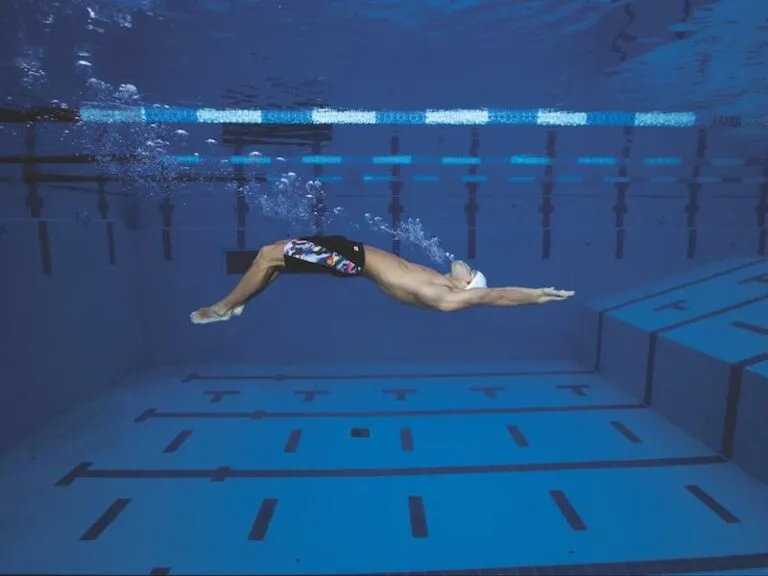
There's a ritual in nearly every competitive swim practice in America. Coach blows the whistle, swimmers grab their kickboards, and for the next 20 minutes, everyone churns up and down the lane in a slow, splashy parade. It feels productive. It looks like work. And for a lot of swimmers, it's become gospel—if your kick is weak, you do more kick sets. Simple.
Except it's not that simple. And for a growing number of sports scientists and elite coaches, the kickboard-heavy approach is starting to look less like smart training and more like a habit nobody's bothered to question.
Let's dig into what's actually going on when you kick, why isolated sets have real limits, and why the squat rack and the yoga mat might do more for your 100 fly than another 400 kick ever will.
What Your Kick Is Actually Doing (And What It Isn't)
Here's a number that tends to surprise people: in freestyle, your kick contributes somewhere between 10 and 30 percent of total propulsion depending on the swimmer and the distance. For sprint events, that number climbs. For distance swimming, it drops significantly—and your kick's primary job shifts from propulsion to body rotation and balance.
So right off the bat, the idea that a stronger kick automatically means faster swimming is an oversimplification. Kick mechanics are more about rhythm, timing, and postural control than raw leg power. And that's where dryland training becomes a completely different conversation.
When you isolate the kick with a board, you're training one component in a completely artificial context. Your body position is different. Your hip engagement is different. The neural pattern you're reinforcing doesn't perfectly mirror what happens when you're actually swimming at race pace. You're getting some benefit, sure—but you're leaving a lot on the table.
The Real Engine: Core, Hips, and Glutes
If you want to understand where real propulsion and body control come from, you have to look at the kinetic chain. Every powerful freestyle stroke and every efficient butterfly pull starts from the center of the body and radiates outward. That means your core isn't just some abstract fitness concept—it's the literal transmission between your upper and lower body.
Weak core, and you lose energy transfer. Your rotation gets sloppy. Your hips drop. Suddenly you're fighting drag you created yourself.
Same goes for hip mobility and glute activation. The flutter kick originates at the hip, not the knee. Swimmers who generate most of their kick motion from the knee rather than the hip are working harder and getting less out of it. When hip flexors are tight—which they often are in athletes who spend a lot of time horizontal in the water—the glutes can't fire properly, and the whole system becomes less efficient.
This is why a swimmer who can barely kick 100 yards on a board might still have a devastating race-pace kick: because their hip mobility, core stability, and posterior chain strength are doing the heavy lifting that pure kick volume never addressed.
Why Volume Alone Is a Dead End
The "just swim more" mentality is deeply embedded in American swim culture. More yardage, more kick sets, more time in the water. And look, volume matters—nobody's saying otherwise. But there's a point of diminishing returns, and a lot of age group and masters swimmers hit that wall without realizing it.
When you keep stacking water volume on top of existing movement patterns—especially inefficient ones—you're not building a better swimmer. You're just making a more practiced version of whatever you already are. If your hip flexors are tight, 10,000 yards a week makes you really, really good at swimming with tight hip flexors.
Dryland training breaks that cycle. It lets you address the root causes of inefficiency rather than training around them indefinitely.
A Dryland Routine That Actually Transfers
You don't need to turn into a gym rat to make this work. Even two focused sessions per week—30 to 45 minutes each—can create measurable changes in your water performance within a few weeks. Here's a framework that competitive swimmers at every level can integrate without sacrificing pool time.
Glute Activation Warm-Up (5 minutes) Start every dryland session with glute bridges and clamshells. These aren't glamorous, but they wake up the posterior chain that most swimmers chronically underuse. Three sets of 15 reps each. You want to feel your glutes burning before you even break a sweat.
Hip Mobility Circuit (10 minutes)
- Deep lunge with thoracic rotation: 8 reps per side
- 90/90 hip stretch: 60 seconds per side
- Leg swings (front-to-back and lateral): 15 reps each direction
This is the stuff that directly addresses the hip flexor tightness that kills kick mechanics. Do this consistently and you'll notice your body position in the water improving within a few weeks.
Core Stability Work (15 minutes) Forget crunches. Swimmers need anti-rotation and anti-extension strength—the kind that keeps your hips from dropping and your torso from wobbling.
- Dead bugs: 3 sets of 10 reps per side
- Pallof press (use a band or cable machine): 3 sets of 12 per side
- Plank with alternating leg lift: 3 sets of 30 seconds
Posterior Chain Strength (15 minutes)
- Romanian deadlifts: 3 sets of 8–10 reps (moderate weight, focus on hip hinge)
- Single-leg glute bridge: 3 sets of 12 per side
- Banded hip thrusts: 3 sets of 15
None of this requires a fancy gym membership. Resistance bands, a mat, and a set of dumbbells will get you most of the way there.
How to Work This Into Your Training Week
The easiest approach is to schedule dryland immediately after a shorter or lower-intensity pool session—not before a hard workout. You want your legs fresh when you're racing or doing threshold sets. Post-practice dryland on your recovery days keeps the interference minimal.
If you're training with a club or masters group, talk to your coach about replacing one kick-heavy set per week with a focused dryland session. Most coaches who've seen the research are receptive, especially when athletes come in with data and a concrete plan.
The Bottom Line
The kickboard isn't evil. It has a place in technique work, in recovery sets, and in certain developmental contexts. But treating it as the primary solution for a weak kick is like patching a tire without figuring out what caused the flat.
Your kick lives downstream from your hips, your core, and your posterior chain. Fix the source, and the kick often fixes itself. That's not a theory—it's biomechanics. And it's the kind of training insight that can genuinely drop time off your splits without adding a single yard to your weekly volume.
Gear up, do the work on land, and watch what happens when you get back in the water.