Comeback Protocol: How Competitive Swimmers Train Through Injury Without Losing Their Edge
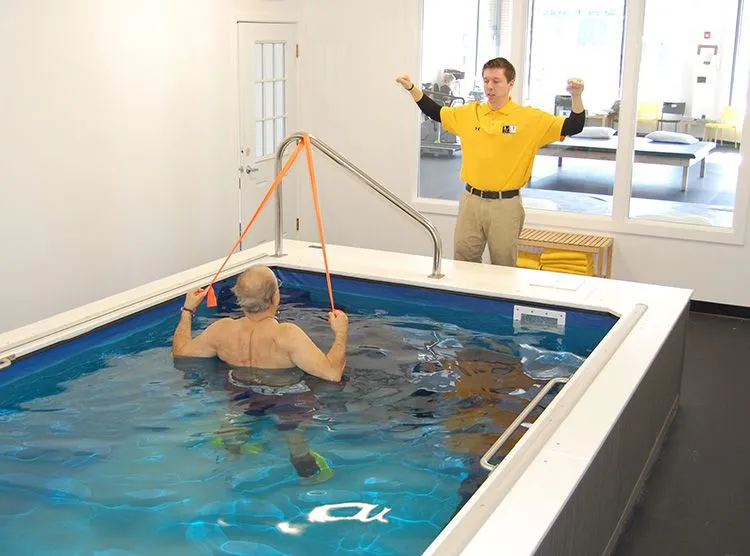
Photo: swimmer physical therapy shoulder rehabilitation pool training, via img2.storyblok.com
Ask any competitive swimmer what their biggest fear is and the answer usually isn't a bad race or a slow split. It's the shoulder. Or the knee. Or the lower back that's been quietly building a case against them for two seasons. Injury is the shadow that follows every serious swimmer, and when it finally catches up, the question isn't just "will I recover?"—it's "will I recover fast enough to matter?"
The good news is that the athletes who handle injury best aren't just genetically fortunate or blessed with a great surgeon. They have a system. And most of it is learnable.
Understanding What You're Actually Dealing With
Shoulder injuries are the most common threat to a swim career in the US, with studies suggesting that up to 91 percent of elite swimmers experience shoulder pain at some point. Swimmer's shoulder—a broad term covering rotator cuff tendinopathy, subacromial impingement, and labral irritation—is almost always the product of volume and mechanics colliding over time. The same goes for lower back issues, which plague butterfly and breaststroke specialists in particular, and knee problems that disproportionately affect breaststroke swimmers due to the whip kick's lateral stress on the joint.
Knowing your specific injury matters enormously before you start modifying training. A rotator cuff strain and a labral tear require very different approaches. A swimmer who treats both the same way is either undertreating one or overtreating the other. Get imaging, get a diagnosis, and then—critically—find a sports medicine provider who actually works with swimmers. A general orthopedist and a physician who treats competitive aquatic athletes are not the same resource.
The Mindset Shift That Changes Everything
Here's where a lot of injured swimmers go wrong: they treat the injury as a pause button. They stop training, wait for clearance, and then try to jump back in where they left off. The athletes who make the cleanest comebacks treat the injury period as a redirect, not a stop.
That mental reframe isn't just motivational fluff. It has real training implications. The goal during an injury isn't to maintain your exact pre-injury fitness—that's often impossible. The goal is to preserve as much of your aerobic base, sport-specific strength, and neuromuscular conditioning as you can while giving the damaged tissue the environment it needs to heal.
Those two things can coexist. You just have to get creative.
What You Can Do in the Water
For shoulder injuries, the default assumption is "no swimming." But that's rarely the full picture. Kicking sets with a board or in a streamline position (if your shoulder tolerates it) can maintain cardiovascular fitness without loading the injured structures at all. Pull buoy work with a modified stroke—sometimes even one-arm drills on the unaffected side—can keep your feel for the water alive.
Leg-dominant strokes like backstroke kick and flutter kick with fins are often fully available even when your shoulder is completely off-limits. These aren't consolation prizes. They're legitimate training tools that elite swimmers use deliberately even when healthy.
For knee injuries common in breaststrokers, the situation flips. Freestyle and backstroke pull sets with a buoy—eliminating the kick entirely—can keep a swimmer race-fit for months. Some athletes have maintained top-10 national times while managing chronic knee issues specifically because they leaned hard into upper-body-dominant training.
Dryland Training as Your Secret Weapon
This is where the right gear becomes a genuine performance factor, not just a comfort consideration. Resistance bands are the cornerstone of shoulder rehab and maintenance for swimmers—specifically the external rotation and scapular stabilization work that most swimmers chronically neglect when healthy. Brands like TheraBand and SPRI make band kits specifically designed for rotator cuff protocols, and they're cheap enough that there's no excuse not to have a set in your bag.
For athletes dealing with lower back issues, a quality foam roller and a lacrosse ball can address the hip flexor and thoracic spine tightness that often drives lumbar pain in butterfly swimmers. Dry-land core work—specifically anti-rotation and lateral stability exercises rather than traditional crunches—builds the spinal stability that protects swimmers long-term.
Swimmers coming back from knee surgery have found real success with aqua jogging using a flotation belt. It's not glamorous, but it's a near-perfect cardiovascular substitute that keeps the aerobic engine running without joint compression. Several collegiate swimmers have used aqua jogging to return from ACL repairs faster than their medical teams initially projected.
Real-World Comebacks: What Athletes Actually Did
National-level masters swimmer Dana Vollmer—who returned to competition after a shoulder reconstruction—has spoken publicly about how she restructured her entire training philosophy around injury prevention after her surgery. The short version: she added more targeted strength work, reduced unnecessary yardage, and became obsessive about sleep and recovery. She came back not just healthy but faster in certain events.
At the collegiate level, it's increasingly common for programs at schools like Texas, Stanford, and Cal to employ dedicated sports performance staff who create parallel training tracks for injured athletes. These swimmers don't disappear from the program—they shift to a different lane, literally and figuratively, and maintain their conditioning through structured alternatives.
The pattern across successful comebacks is consistent: early diagnosis, honest communication with coaching staff, a diversified training approach during recovery, and a gradual return-to-volume protocol rather than a sudden jump back to full practice.
The Gear That Helps You Stay In It
A few pieces of equipment make the injury-modified training life significantly more manageable. A high-quality pull buoy—look for something with good buoyancy and a comfortable grip—becomes your best friend if your lower body is the problem. Fins with a shorter, stiffer blade (as opposed to the long freediving style) allow for more controlled kick training without the torque stress that long blades create. And a well-fitted swim snorkel can be genuinely therapeutic for shoulder issues, since it eliminates the rotational breathing that often aggravates impingement.
None of these are substitutes for medical care. But they're the tools that let you stay in the water, stay in shape, and stay connected to the sport while your body does the work of healing.
The Long Game
The swimmers who come back from injury and genuinely improve—and they exist, in real numbers—share one trait above everything else: they used the forced downtime to address the weaknesses they'd been ignoring. The shoulder that finally gave out was often compensating for poor scapular stability for years. The knee that buckled was the downstream result of hip imbalances that never got corrected.
An injury isn't the end of your competitive story. For a lot of swimmers, it's the chapter where they finally figure out how to train smarter than they were before.
Stay in the water however you can. The comeback is built in those in-between moments.